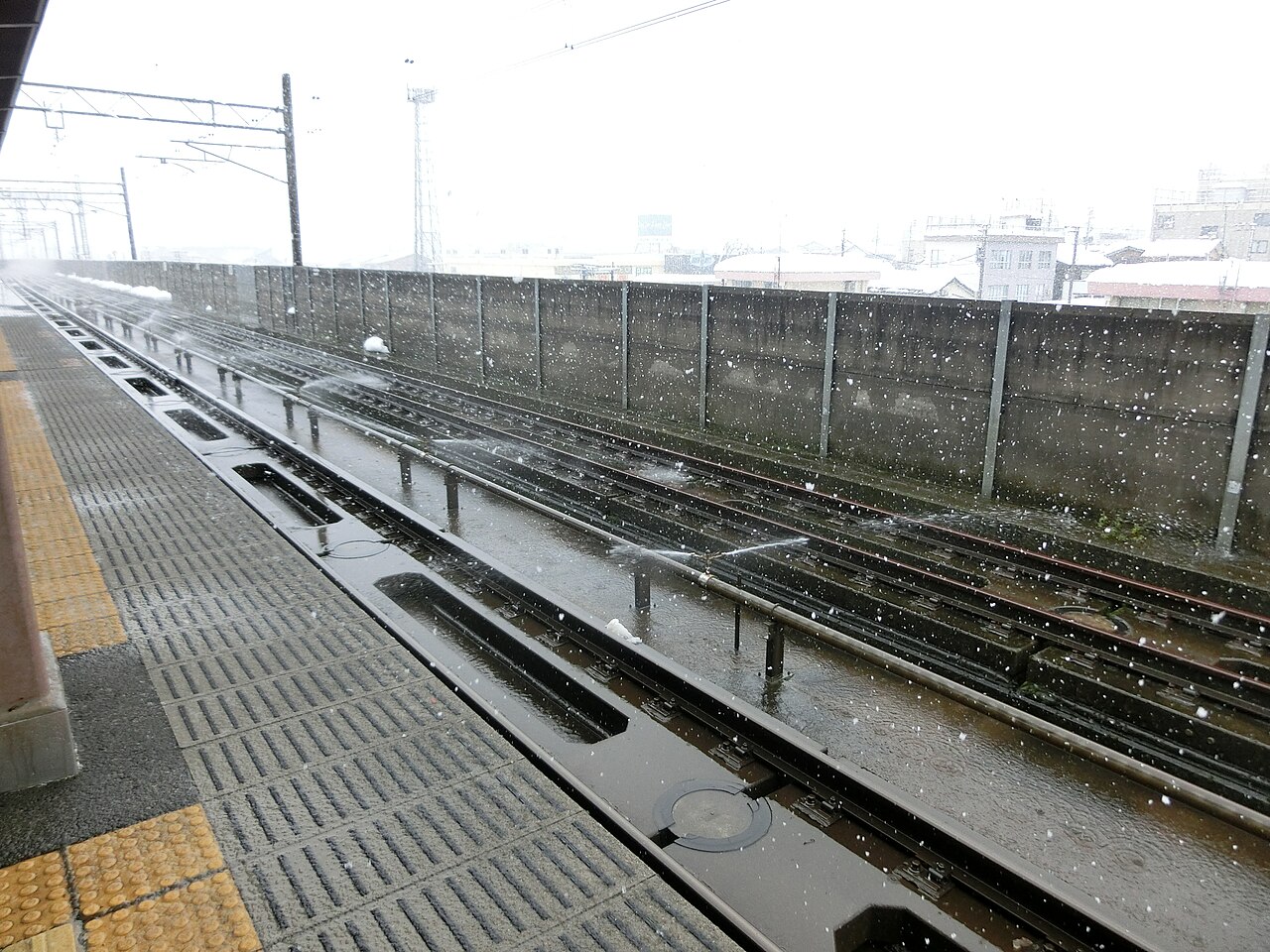
Photograph: Snow-melting sprinkler at Tōkamachi Station, elsewhere in Niigata Prefecture. Abasaa · Public domain
Snow is falling in Nagaoka, yet water is coming up through the road. At first glance a line of little fountains in the middle of a street looks like one more winter problem. In this part of Niigata Prefecture the fountains are the answer. Look for the Japanese words 消雪パイプ, shōsetsu paipu, on the city’s diagrams: they mean pipes for melting snow.
Why ordinary groundwater is warm enough
The prefecture puts local groundwater at roughly 12–13°C even in winter. That would make a chilly bath, but it is warm enough to melt snow. A pump brings the water up, buried pipes distribute it and nozzles let it out onto the road. The small jets spread the water across the surface. On installations fitted with a snow sensor, snowfall itself can trigger the pump.
Nagaoka began using the system on public roads in 1961. Heavy snow in the winter of 1963 drew wider attention to it. You can read those dates as part of a very local calculation. Water that is available underground and stays above freezing can keep a road usable without first lifting all the fallen snow onto a truck. A town with a different water supply cannot simply copy that calculation.
What happens before the first flakes
Come when there is no snow and the most conspicuous part of the installation disappears. The nozzles are still there. Niigata Prefecture describes flushing sediment from pipes and checking the spray before the season. A row of tiny openings only works as well as the water that can get through them.
There is also a cost underground. Nagaoka asks residents and businesses to conserve groundwater because the pumping concentrated during heavy snowfall can contribute to land subsidence. The next time you see the spray, look at where it stops as well as where it starts. The system serves particular stretches of road, and the water beneath them is a shared, finite resource.
Sources and further details
- Nagaoka City on the invention of the snow-melting pipe
- Niigata Prefecture on how the system works
- Nagaoka City on groundwater conservation




Comments